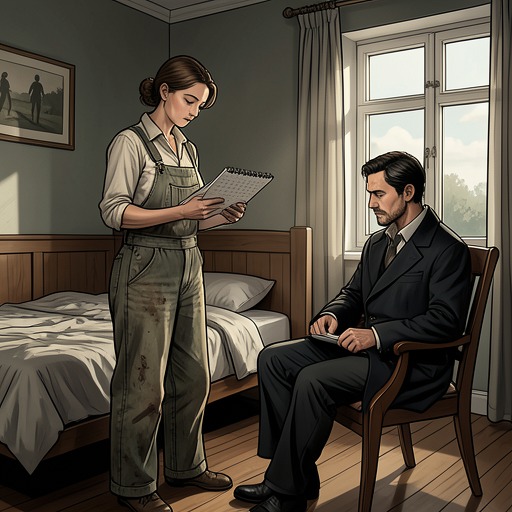
The Cottages
Never Let Me GoThe Cottages are a group of converted farm buildings where eight students from Hailsham spend the first part of their lives beyond school. To the newcomers, the place initially seems like Hailsham for older students, but its failing buildings, improvised heating, and loose connection to their former school expose how little they understand about the world around them. In Kathy H.’s recollections, the Cottages become both a real, uncomfortable residence and a temporary container for Hailsham habits, friendships, and hopes that gradually lose their hold.
Setting and Conditions
The Cottages occupy the remains of a farm that had ceased operating years before the students arrived. An old farmhouse stands at the centre, surrounded by barns, outhouses, and stables converted into living quarters. Some outlying buildings are so close to collapse that the students cannot use them, yet they feel vaguely responsible for their upkeep. The compound is therefore neither a functioning farm nor a purpose-built school: it is a reused, imperfect environment whose neglected edges remain part of the students’ daily surroundings.
Keffers, a grumpy older man who visits two or three times a week in a muddy van, oversees the property. He rarely talks to the students. His sighs and disapproving head-shakes suggest that he considers their efforts inadequate, although the students do not know what more he expects. He has given them a chore list, and the students who were already resident—the veterans, as Hannah calls them—have established a rota that the newcomers follow conscientiously. Beyond those duties, practical responses to the property’s decay are limited: students can report leaking gutters and mop up after floods, but the deteriorating buildings remain beyond their control.
The farmhouse’s fireplaces can burn split logs stored in the outer barns, but otherwise warmth depends on large, boxy heaters that use gas canisters. Keffers will not leave a large supply unless the weather is very cold, and the students’ repeated requests for more meet his suspicion that they might waste the canisters or cause an explosion. Outside summer, they often wear two or three jumpers; their jeans feel cold and stiff, and they sometimes keep their Wellington boots on all day, tracking mud and damp through the rooms. Keffers disapproves of the muddy floors but offers no alternative when challenged. The Cottages’ discomfort is not dramatic so much as persistent: heat, shelter, and maintenance depend on restricted supplies and on an overseer whose expectations are never clearly explained.
Arrival and the Hailsham Connection
Eight students leave Hailsham for the Cottages in the same summer. Other students go to the White Mansion in the Welsh hills or to Poplar Farm in Dorset. At first, the Hailsham group does not understand that these residences have only tenuous connections with their old school. They arrive expecting a version of Hailsham adapted for older students, and for a time continue to interpret their new surroundings through that expectation. They pay little attention to who runs the Cottages, how the place fits into the larger world, or what lies beyond their immediate life there.
The essays assigned by the Hailsham guardians accompany this transition. At Hailsham, the students have been urged to choose topics that might sustain as much as two years of work, but they do not really believe the essays matter. Once they reach the Cottages, however, the unfinished work takes on the character of a farewell gift from the guardians. It helps the new arrivals stay afloat while they adjust to unfamiliar surroundings. Kathy H. remembers choosing Victorian novels for her own essay without much thought, and remembers Miss Emily recognizing that lack of conviction without pressing her. The essay’s importance is thus less a matter of academic ambition than of what it temporarily carries: a connection to Hailsham that the students fear losing as their new life takes shape.
That attachment weakens over time. More students begin leaving to train as carers, and among the Hailsham group this increasingly seems like the natural next step. They are allowed to begin training without finishing their essays. What once would have seemed unthinkable gradually becomes ordinary as Hailsham recedes in memory and the guardians seem unlikely to return to their lives. Kathy H. tries to preserve the group’s interest in reading and note-taking because she senses that, as the essays fade, so might the bond that identifies them as Hailsham students. The Cottages mark a transition not only from school to adult responsibility but from a shared institutional identity toward separate paths.
Objects, Memories, and Relationships
The Cottages also preserve the students’ creative and social histories in objects. Kathy H. recalls Patricia C.’s small, squat calendar, acquired at an Exchange, with a pencil drawing of Hailsham life for each month. The June and September images show recognizable students and guardians. Kathy H. loses the calendar when she leaves the Cottages, distracted and careless about what she takes; the loss turns an ordinary possession into a record of a former community that cannot simply be revisited. Her memory of the calendar’s particular images gives the Cottages a second life as a place from which fragments of Hailsham are carried away, misplaced, and later recalled.
Tommy’s animal drawings gather a more difficult history. At the Cottages, Kathy H. wants to show him the calendar, partly because she is proud of it, but the history surrounding his drawings makes their conversations about his work fraught. Later, after the churchyard conversation has unsettled the relationship between Kathy H., Tommy, and Ruth, Kathy H. feels unable to approach Tommy and explain or apologize as she might have earlier. She and Tommy never discuss the animals or what happened in the churchyard. The silence persists even while their outward interactions appear much as before, and Ruth and Tommy continue making a show of being a couple. The place is therefore associated with a break in the ease Kathy H. once expected between herself and Tommy: the past remains present, but no longer readily speakable.
The drawings nevertheless connect the Cottages to a later period. When Kathy H. becomes Tommy’s carer at the Kingsfield recovery centre, she finds him working in a notebook that resembles the black books he had obtained from Keffers years earlier. He has returned to drawing imaginary creatures. His frogs remind her of the earlier work but seem less fresh, more laboured, almost copied. That comparison makes the Cottages a standard against which the later work is measured: the drawings offer a way of putting old hurt behind them, while their changed quality reminds Kathy H. that some opportunities for making or repairing things have already passed.
Rumors and Life Beyond the Residence
The Cottages are also where the students’ expectations about their future become entangled with rumor. Chrissie tells the Hailsham group that she and Rodney heard that, in special circumstances, former Hailsham students could obtain a deferral of their donations for three or four years. According to the story, a boy and a girl who were genuinely in love and could demonstrate it might be allowed time together before beginning their donations. The account gives the Cottages a role as a place where uncertain stories circulate, even when the students do not know whether those stories describe a real possibility. The rumor draws on the group’s belief that their Hailsham background might confer a special advantage, a belief that coexists with their incomplete understanding of how their residence fits into the wider world.
Later, as a carer, Kathy H. remembers talking with Ruth on the balcony of a recovery room about Hailsham and the Cottages. Those conversations show that the old residence has survived as shared subject matter long after the friends have left it. Yet recollection does not restore the students’ earlier closeness or make their past fully available. In the final phase of Tommy and Kathy H.’s attempt to seek a deferral, Kathy H. suggests that they might return to the Cottages if they are granted time together, though she thinks another place, perhaps the White Mansion, might be better. Even in imagining a future together, the students look back toward familiar sites while recognizing that a centre is not a home and that the old residence may not be suitable either.
Narrative Significance
The Cottages are defined by a contrast between the students’ expectations and the conditions they actually encounter. They imagine continuity with Hailsham, but live in a poorly maintained former farm whose management is obscure and whose comforts depend on limited provisions. That gap does not immediately make them question their whole situation; instead, essays, routines, friendships, and rumors give them local ways to understand a life whose larger structure they scarcely examine.
Kathy H.’s recollections likewise make the place both specific and unstable. Muddy floors, gas heaters, leaking gutters, a lost calendar, and a notebook associated with Keffers fix the Cottages in material details. But these details return through later memories, carrying the altered meaning of separation, missed conversations, and work that has changed with time. The Cottages are not simply a bridge between Hailsham and what follows. They are the setting in which the students try to carry Hailsham forward, and in which the limits of that effort begin to show.